
 B52
B52 Casino
 Nổ Hũ
Nổ Hũ Bắn Cá
 Thể Thao
 Đá Gà
Đá Gà Esports
 Xổ Số
Xổ Số Khuyến Mãi
 Đại Lý B52Club
Surprising stat to start: a non-trivial share of wallet compromises and costly mistakes in DeFi arise not from lost seeds but from “blind signing”—users authorizing transactions without understanding the exact state change they cause. Rabby Wallet treats that problem not as a UX footnote but as a core engineering constraint. For experienced DeFi users operating across chains and contracts, transaction simulation (alongside tools like approval revocation and hardware-wallet integration) reframes how you trade speed for safety and convenience for auditability.
This piece is a side-by-side analysis aimed at power users in the US who already juggle multiple EVM chains, DEXes, and leverage positions. I explain how Rabby’s pre-transaction simulation works mechanically, compare it to more familiar alternatives, unpack limits and failure modes, and close with a practical decision framework: when Rabby materially improves your risk profile and when its trade-offs matter.
How Rabby’s Transaction Simulation Works (Mechanics, not marketing)
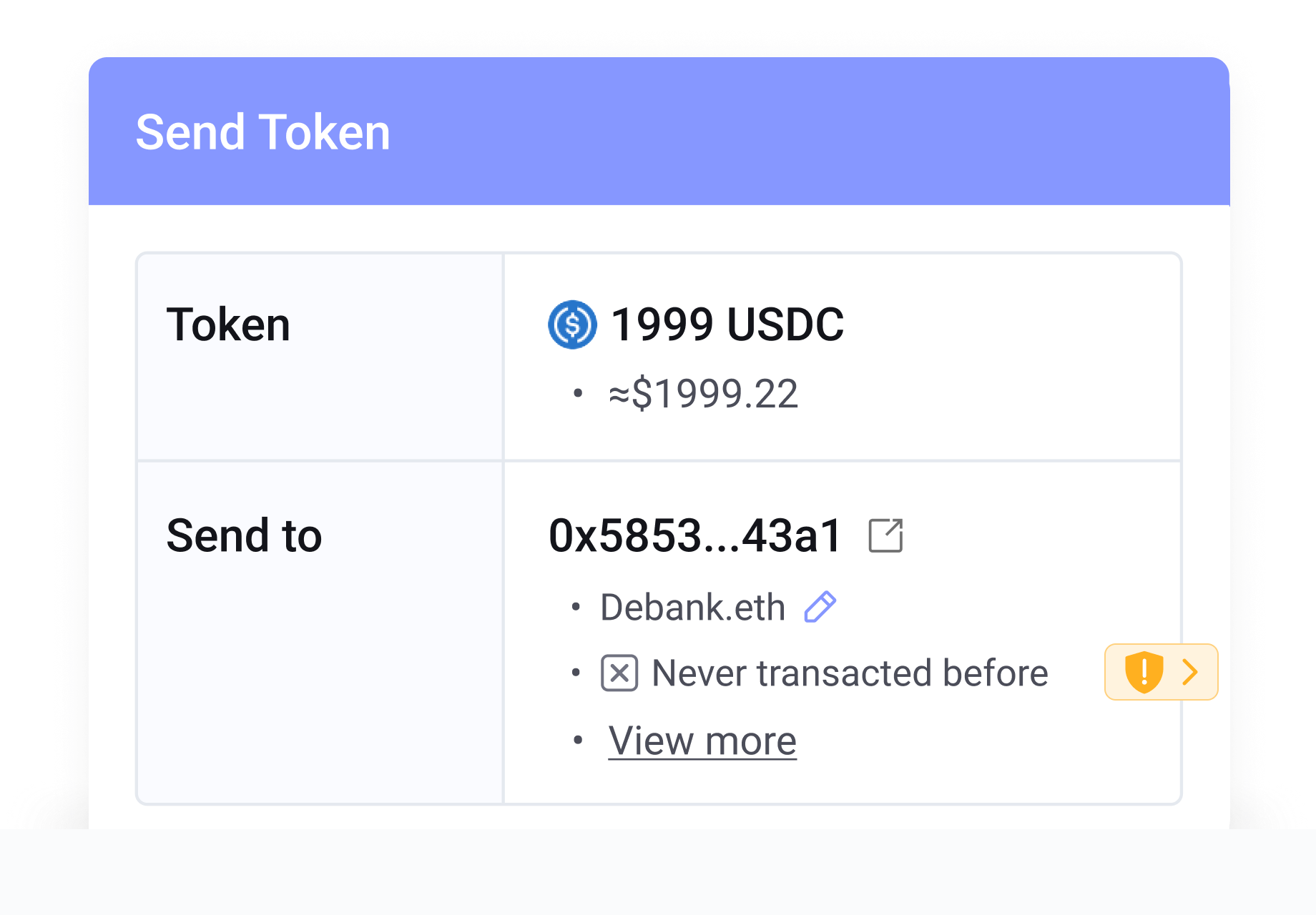
At its core, a transaction simulator executes a dry-run of the intended transaction against a node or local EVM execution environment and inspects the post-execution state. Mechanically this means the wallet constructs the same calldata and value, submits it to an RPC or in-process VM, and then reads out the predicted balance changes, token transfers, emitted events, and gas used. Rabby surfaces that readout to the user as explicit delta numbers: “You will lose X token, gain Y token, and spend Z in gas.”
This contrasts with simpler wallets that show only the calldata, target address, and a gas estimate. Simulation converts an abstract call into a concrete accounting of assets. For a DeFi power user, that matters because complex interactions—swaps with slippage, permit-based approvals, multi-step Router calls, or batched contract actions—frequently mask hidden transfers or approvals. Simulation exposes those side-effects before you sign.
Two implementation choices matter: where simulation runs, and which state snapshot it uses. Running simulation locally reduces trust in external RPC nodes but costs client CPU and memory; querying a remote node is faster but adds attack surface if that node is compromised or out-of-sync. Rabby balances this by leveraging public and user-configured RPCs and importing known-chain state where practical. The wallet then layers a security engine that flags common risk patterns: hacked contract addresses, suspicious approval sizes, or non-existent recipients.
Side-by-side: Rabby vs. MetaMask and Other EVM Wallets
MetaMask is the yardstick: widely deployed, integrated with most dApps, but historically oriented toward minimal UI friction rather than explicit simulation. Trust Wallet and Coinbase Wallet prioritize mobile convenience and fiat on-ramps. Rabby’s differentiators are explicit: built-in transaction simulation, automated network switching, approval revocation, cross-chain gas top-up, and deeper hardware wallet integrations. These features produce different trade-offs.
Trade-off 1 — Safety vs. speed: Rabby’s simulations add a small confirmation step but reduce “surprise” errors. For traders executing high-frequency strategies, that friction could be a cost. For users managing large positions or interacting with unfamiliar contracts, the cost is justified by fewer catastrophic errors.
Trade-off 2 — Transparency vs. trust surface: Simulations that rely on external RPCs inherit those RPCs’ integrity assumptions. Rabby mitigates this with multiple RPC support and an open-source codebase, but the user still needs to be aware: simulation output is only as good as the state snapshot it uses.
Trade-off 3 — Feature completeness vs. ecosystem reach: Rabby lacks a built-in fiat on-ramp and in-wallet staking. If you want a single-surface solution that covers buying, staking, and casual custodial convenience, other wallets may be better. If you prioritize pre-sign controls, hardware-wallet support, and cross-chain operations, Rabby is architected for you.
Where Rabby’s Simulation Helps—and Where It Can Break
Practical wins: simulation prevents large unintended approvals and reveals sandwichable or slippage-prone swaps. It helps when you interact with router contracts that bundle multi-leg operations (for example, swapping token A for C via token B), because it will show the effective token deltas rather than just the initial call. The built-in revocation tool then lets you close lingering exposure.
Failure modes worth knowing: first, dependent on RPC freshness. If a node lags or is censored, simulated gas costs and balance snapshots can be inaccurate, producing false reassurance. Second, simulation cannot predict off-chain or oracle-driven failures that trigger at execution time—front-running, miner reordering, or a manipulated price oracle on-chain can still alter the actual outcome. Third, past incidents: Rabby’s own history includes a 2022 contract exploit related to Rabby Swap. The team froze the contract, reimbursed users where possible, and increased audits—showing both institutional responsiveness and that no system is immune.
Finally, human factors: a clear simulation output is only useful if users read and understand it. For high-volume traders, the temptation to “rubber-stamp” results remains. The simulation reduces risk but does not eliminate the need for informed judgment and operational discipline.
Practical Installation and Integration Notes (Rabby Install and Setup)
Rabby ships as a Chromium extension (Chrome, Brave, Edge), mobile apps, and desktop clients for Windows and macOS. Power users frequently adopt the browser extension for direct dApp interaction and pair it to a hardware wallet for signing critical transactions. When installing in the US context, follow standard best practices: download from verified stores or project pages, verify extension permissions, and import accounts via seed phrase only in a secure environment.
Rabby supports importing existing wallets via seed phrase or private key, and offers a ‘Flip’ toggle for users who prefer MetaMask as default on certain sites. For institutional or multi-sig setups, Rabby integrates with solutions like Gnosis Safe and Fireblocks. If you run multiple accounts, pair Rabby with a hardware wallet (Ledger, Trezor, Keystone, and others are supported) so the private keys never touch the browser process.
One useful operational pattern: use Rabby in a layered-privilege model. Keep a hot account for small trades and gas; keep larger balances in a hardware-protected account accessible only when necessary. Rabby’s cross-chain gas top-up is useful when a new chain lacks gas tokens: you can top up a small amount remotely to cover necessary signing fees without moving large principal amounts.
Decision Framework: When to Choose Rabby
Heuristic 1 — You should consider Rabby if:
- You interact frequently with unfamiliar contracts or aggregators and want deterministic previews of token deltas.
- You manage large balances and need built-in approval revocation and hardware-wallet workflows.
- You operate across many EVM chains and value automatic network switching and cross-chain gas mechanics.
Heuristic 2 — Consider alternatives or complementary tools if:
- You need native fiat on-ramp or in-wallet staking as primary workflows.
- You require a wallet with maximal mobile-first simplicity and custodial convenience.
- Your operational model demands minimal latency for ultra-high-frequency trading where an extra confirmation step is prohibitive.
For a US-based DeFi operator who values security hygiene and auditability, Rabby’s simulation and revocation tooling materially lower certain classes of operational risk—provided you understand the limits of simulation and keep RPC and key-management hygiene tight.
What to Watch Next (Signals and Conditional Scenarios)
Watch these signals to reassess whether Rabby is gaining or losing tactical advantage: broader adoption of on-chain meta-transactions and account abstraction could change the cost-benefit calculus of pre-execution simulation; if more dApps sign and batch operations server-side, simulation tooling will need to evolve to model off-chain coordination. Improvements in oracle robustness and MEV mitigation would reduce oracle-driven unpredictability—strengthening the value of pre-sign simulation where it currently cannot account for oracle manipulation. Conversely, if wallets ship native fiat rails and staking, the competitive landscape will emphasize integrated convenience rather than granular simulation.
None of these are certainties. They are conditional scenarios to monitor; each depends on developer incentives, regulatory trajectories in the US for on-ramps, and technical evolution in EVM tooling and MEV defenses.
FAQ
How does Rabby prevent “blind signing” better than other wallets?
Rabby runs a pre-sign simulation of the transaction and presents concrete token balance changes and fee estimates. That converts an opaque calldata payload into an intelligible asset delta. It also runs risk scans that flag hacked contracts or suspicious approvals. The limitation: simulation quality depends on the freshness and integrity of the RPC/state source and cannot guarantee against off-chain maneuvers like front-running.
Can I use Rabby with a hardware wallet and multi-sig setups?
Yes. Rabby supports Ledger, Trezor, Keystone, CoolWallet, GridPlus, BitBox02, and integrates with institutional and multi-sig services like Gnosis Safe and Fireblocks. For high-value operations, combine Rabby’s simulation with hardware signing so private keys remain isolated from the browser.
Does Rabby let me buy crypto with USD inside the wallet?
No. Rabby currently lacks a built-in fiat on-ramp. You must use an external exchange or on-ramp service and then import assets into the wallet. This is a deliberate trade-off: Rabby focuses on transaction security and DeFi tooling rather than integrated fiat rails.
Is Rabby safe after its 2022 incident?
The 2022 Rabby Swap contract exploit resulted in losses; the team froze the contract and compensated affected users and increased audits. That episode illustrates two points: no system is infallible, and transparent incident response plus audits are meaningful mitigations. Rabby is open-source and has since emphasized security tooling, but users should still apply best practices—hardware keys, small initial approvals, and periodic revocation.
In sum: Rabby is not a magic bullet, but it is a meaningful engineering response to a specific and measurable failure mode in DeFi: blind signing. If your workflow prioritizes precision, auditability, and multi-chain operations, it provides tools that reduce operational risk in ways that materially matter for high-stakes activity. For readers ready to test it in practice, start with small transactions, pair it with a hardware wallet, and use the built-in revocation and simulation features as part of a disciplined operational playbook—then reassess how much friction you are willing to accept for that incremental safety.
To learn more about the features and installation options, visit this project page for the rabby wallet.